Blog /
IWM puts: $142 banked in 17 days, and the next put sold
The first IWM put passed its 50% profit target. The rules bought it back at $1.03 for a $142.21 gain in 17 days, and sold a December 267 put for $2.69. The new break-even is $264.32, about 7% below IWM.
By Team Iron Wheel
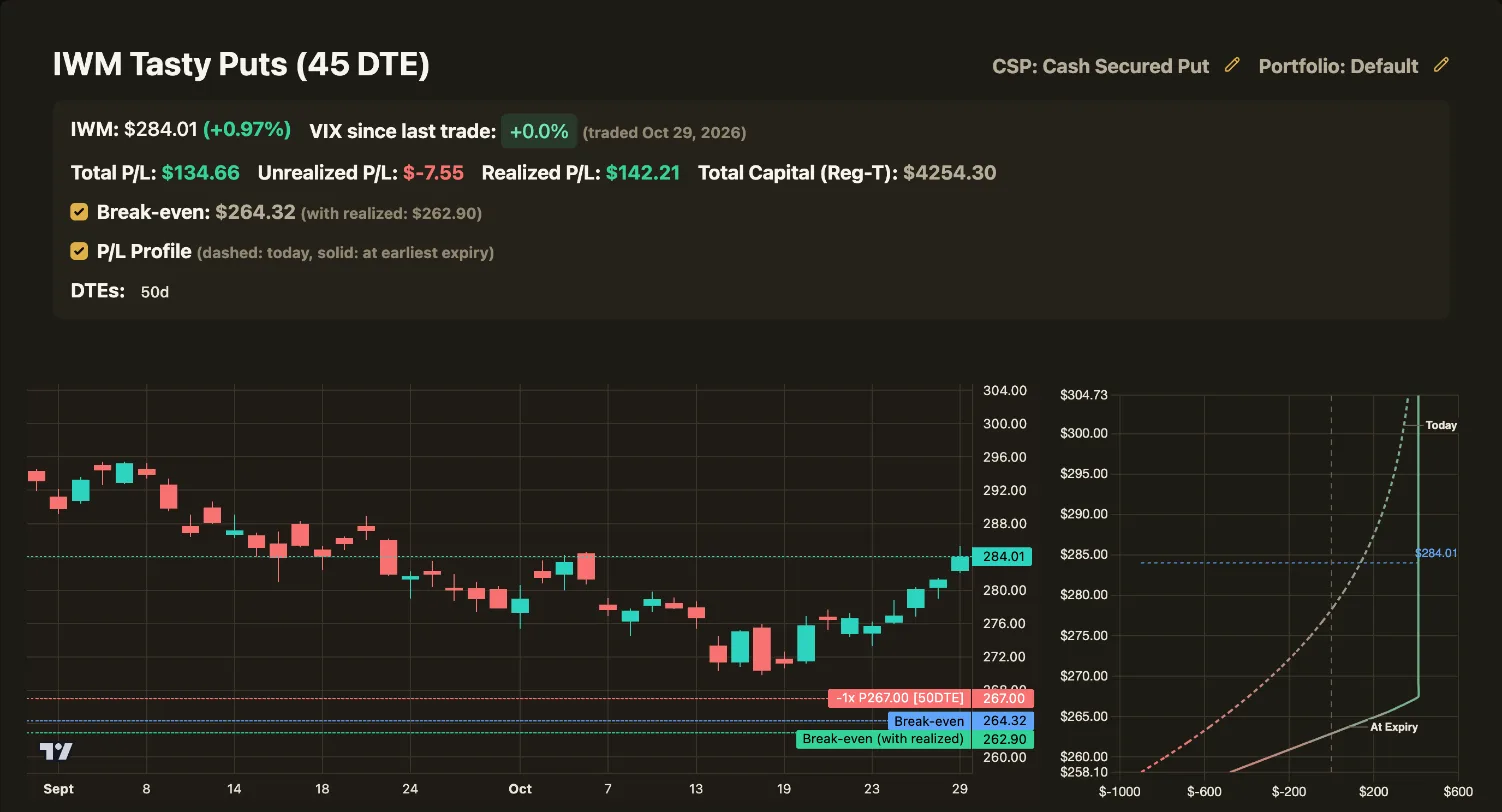
The first IWM put passed its 50% profit target on Thursday, with 29 days still to run. The rules took the gain, $142.21 in 17 days, and sold the next put in the same minute. The new one expires December 18, and its break-even sits about 7% below IWM. The figures are from The Iron Wheel at Thursday's close, October 29. It is an example for education, not a recommendation.
| At a glance | |
|---|---|
| Closed | Nov 27 264 put, bought back at $1.03 |
| Realized | +$142.21 in 17 days |
| Opened | Dec 18 267 put, sold at $2.69 |
| Days to expiration | 50 |
| Delta | 0.20 |
| Max profit | $267.95; $410.16 for the campaign |
| Max loss | $26,432.05, with IWM at zero |
| Break-even | $264.32; $262.90 with the realized gain |
| Capital | $4,254.30 of Reg-T margin |
| Next trigger | 50% at about $1.35, or 21 days on November 27 |
IWM's bounce
Three days after the sale, the put was $172 under water. Then IWM turned. It climbed 5.2% from its $269.88 low on October 16 to $284.01 at Thursday's close.
The put lost more than half its price on the way. Its delta fell from 0.21 to 0.12, so the position moved like 12 shares of IWM, down from 21.
At the Week 2 review, on Tuesday's close, the put had made 35% of its credit. Two sessions later it was past 50%.
Taking 50%
The rules buy the put back once half the credit is in. Half of $2.47 puts the buy-back at about $1.24. The order filled at $1.03, a minute before Thursday's close, with IWM at about $284.
Realized gain = credit − buy-back − commissions = $247 − $103 − $1.79 = $142.21
That's 58% of the credit, kept in 17 of the put's 46 days. On the $4,417 of margin the put tied up at entry, it's 3.2%.
Closing a winner with four weeks left can feel like leaving money behind. Held to expiration, the put could have earned another $103 at most. It would also have stayed exposed to a drop in IWM for those four weeks. That last $103 is the slowest money in the trade, and the rules don't wait for it.
No standing order
The Week 2 plan still had a good-till-canceled order resting at $1.24. That order is gone. Now the routine is a look at the positions a couple of times a day, with any adjustment in the session's last 30 minutes.
On Thursday the wait most likely helped. A resting order would have filled in the morning, at or a little under $1.24. It can cut the other way, too. A late drop in IWM could lift the put back above the target before the next look.
The roll
Both orders filled in the same second, at 3:59 pm ET:
| Detail | Close | Open |
|---|---|---|
| Order | Buy 1 IWM Nov 27 2026 264 put | Sell 1 IWM Dec 18 2026 267 put |
| Days to expiration | 29 | 50 |
| Price | $1.03 a share, $103 | $2.69 a share, $269 |
| Commission | $1.04 | $1.05 |
| Net | $104.04 debit | $267.95 credit |
Together the two orders took in $163.91.
Like the first, the new put sits at about 20 delta. IWM is $6 higher than on October 12, so the 20-delta strike moved up with it, from 264 to 267.
The credit grew too, from $2.47 to $2.69. By a Black-Scholes estimate, IWM's implied volatility is about 22%, up from 20% at the first sale. The same delta now sells for more.

Max profit, max loss and break-even
- Max profit: $267.95, if IWM stays above $267 through December 18. With the $142.21 already banked, the campaign would finish $410.16 up.
- Break-even: $264.32 at expiration, 6.9% below Thursday's close. Counting the realized gain, IWM can fall to $262.90 before the campaign as a whole is under water.
- Max loss: $26,432.05, with IWM at zero. Below the break-even, the loss grows dollar for dollar with IWM.
- Capital: $4,254.30 of Reg-T margin at the close. Holding the put cash-secured would set aside $26,700.
Break-even = strike − net credit = $267.00 − $2.68 = $264.32
Where it stands
The campaign is up $134.66. That's the $142.21 realized, less $7.55 on the new put, which closed a few cents above its sale price.
No rule applies yet. The put has 50 days to run, at 0.20 delta, right where the rules open.
The plan
- Profit target. Half of $2.69 puts the buy-back at about $1.35. Once the put trades below it, the buy-back goes in during a session's last 30 minutes.
- Friday, November 27. The put reaches 21 days to expiration, on the day after Thanksgiving, when the market closes early. If it's still open then, the rules close it or roll it out to about 45 days. That replaces the November 6 exit in the Week 2 plan.
- Next week. The next weekly review covers all three campaigns.