Blog /
A poor man's covered call on JNJ: the first trade
Covered calls on JNJ without buying the shares: a deep in-the-money call six months out, with a 45-day call sold against it. The rules, the opening trade, the most it can make and lose, and where it stands after the first week.
By Team Iron Wheel
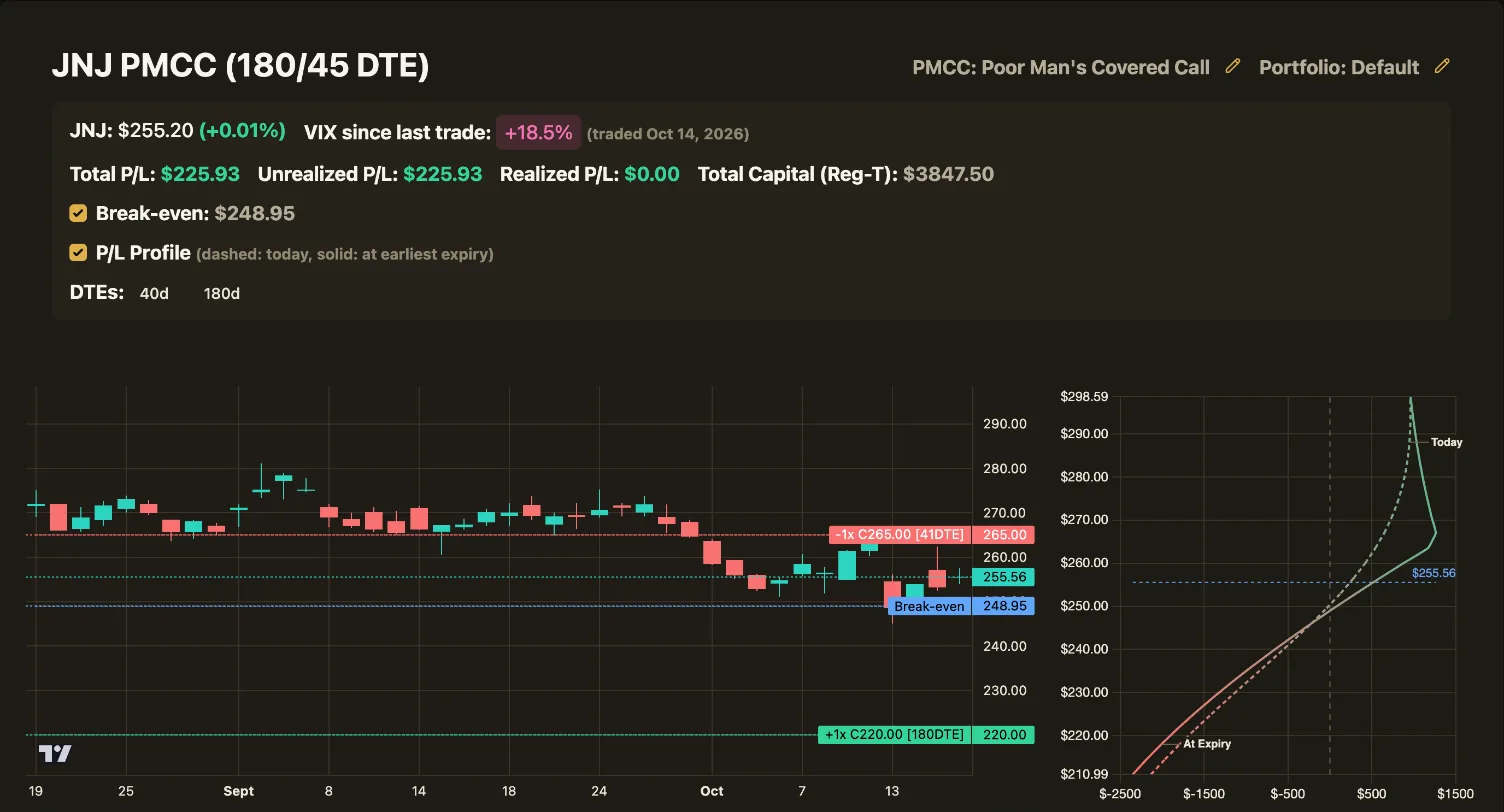
This is the second example campaign on this blog, after the IWM puts: a poor man's covered call (PMCC) on Johnson & Johnson (JNJ), run by fixed rules and recorded in The Iron Wheel trade by trade. It is an example for education, not a recommendation.
The idea
A covered call means owning 100 shares and selling a call against them. A poor man's covered call replaces the shares with a deep in-the-money call that expires months later. At 80 delta that call moves about 80 cents for each dollar JNJ moves, and it costs a fraction of the shares: this one cost about $3,600 net of the first short call, against roughly $25,000 for 100 shares. The PMCC guide covers the structure and what it gives up compared with owning the stock.
The rules
| Leg | Open | Close or roll |
|---|---|---|
| Long call | Buy at about 80 delta, about 180 days to expiration | Under 90 days to expiration, under 0.70 delta, or when the short call is rolled for a debit |
| Short call | Sell at about 25 delta, about 45 days to expiration | At 50% of the credit, or at 21 days to expiration |
The short call follows the same mechanics as the IWM puts, for the same reasons. The long call's rules keep it a good stand-in for the shares:
- 80 delta, 180 days. Deep in the money, most of the long call's price is intrinsic value, which does not decay. With six months to run, the time value on top decays slowly.
- Under 90 days or under 0.70 delta. Late in its life the long call's time decay speeds up, and after a fall in JNJ its delta drops and it stops moving like the shares. Either way it is replaced with a new 180-day, 80-delta call.
- A short call rolled for a debit. That happens when JNJ has rallied through the short strike. The long call is rolled up with it, so the pair is reset around the new price.
The opening trade
Both legs were filled on October 14, 2026, a few minutes apart, and entered on the Add Trade form of a new campaign (strategy: PMCC, underlying JNJ):
| Detail | Long call | Short call |
|---|---|---|
| Order | Buy 1 JNJ Apr 16 2027 220 call | Sell 1 JNJ Nov 27 2026 265 call |
| Days to expiration | 184 | 44 |
| Price | $39.45 a share, $3,945 | $3.25 a share, $325 |
| Commission | $0.78 | $0.79 |
| Net | $3,945.78 debit | $324.21 credit |
Together they cost a net debit of $3,621.57, or $36.22 a share.
The most it can make and lose
- Maximum loss: the debit, $3,621.57. It is reached only if the long call expires worthless, with JNJ below $220 next April. A fall that far by November would cost less, since the long call would still hold months of time value, and the rules roll it long before then, once its delta drops below 0.70.
- Best case this cycle: JNJ at $265 on November 27. The short call expires worthless and the long call is worth its $45 of intrinsic value plus the time value of its remaining 140 days. The P/L profile prices that time value at today's implied volatility and puts the gain at roughly $1,250. It is an estimate that moves with volatility.
- Above $265 the gain is capped, not lost. Past the short strike, each dollar JNJ rises costs the short call a dollar and earns the long call a little less. However far JNJ runs, the pair is still worth at least the $45 between the strikes, so the gain cannot fall below $4,500 − $3,621.57 = $878.43, before the commissions to close. That floor exists only because the $45 strike width is more than the $36.22 paid for it: the one check the PMCC guide insists on before a short call is sold.
Where it stands

JNJ has risen since the trade: it never traded above $253.94 on October 14, and it ended the week at $255.20. The campaign shows an open gain of $225.93, the long call up $346.72 and the short call down $120.79. That is the pair on a moderate rise: the long call, at 0.81 delta, gains faster than the short call, at 0.35, loses. The gain is measured at mid-market marks, and deep in-the-money calls are thinly quoted, so the long call could sell for less than its $42.93 mark.
The break-even at the short call's expiration is $248.95, about 2.5% below Friday's price. None of the rules has been triggered: the short call is marked at $4.45, far from the 50% target, and the long call has 180 days to run at 0.81 delta.
The plan from here
- Short call. A good-till-canceled order to buy it back at about $1.62 takes half the credit. If it is still open on November 6, at 21 days to expiration, it is closed or rolled out to about 45 days and 25 delta.
- Long call. Unless another trigger comes first, it reaches 90 days to expiration in mid-January and is rolled out to about 180 days.
Every roll goes into the same campaign, so the credit from each short call and the cost of each new long call add up on one page. A review of this trade follows in a week.