Blog /
Week 1 review: VIX jumped 31%, and the rules said hold
One week in, VIX jumped 31% and IWM came within 2.2% of the put's strike. The IWM put is nearly flat, the JNJ pair is up $411 with its short call in the red, and no rule calls for a trade.
By Team Iron Wheel
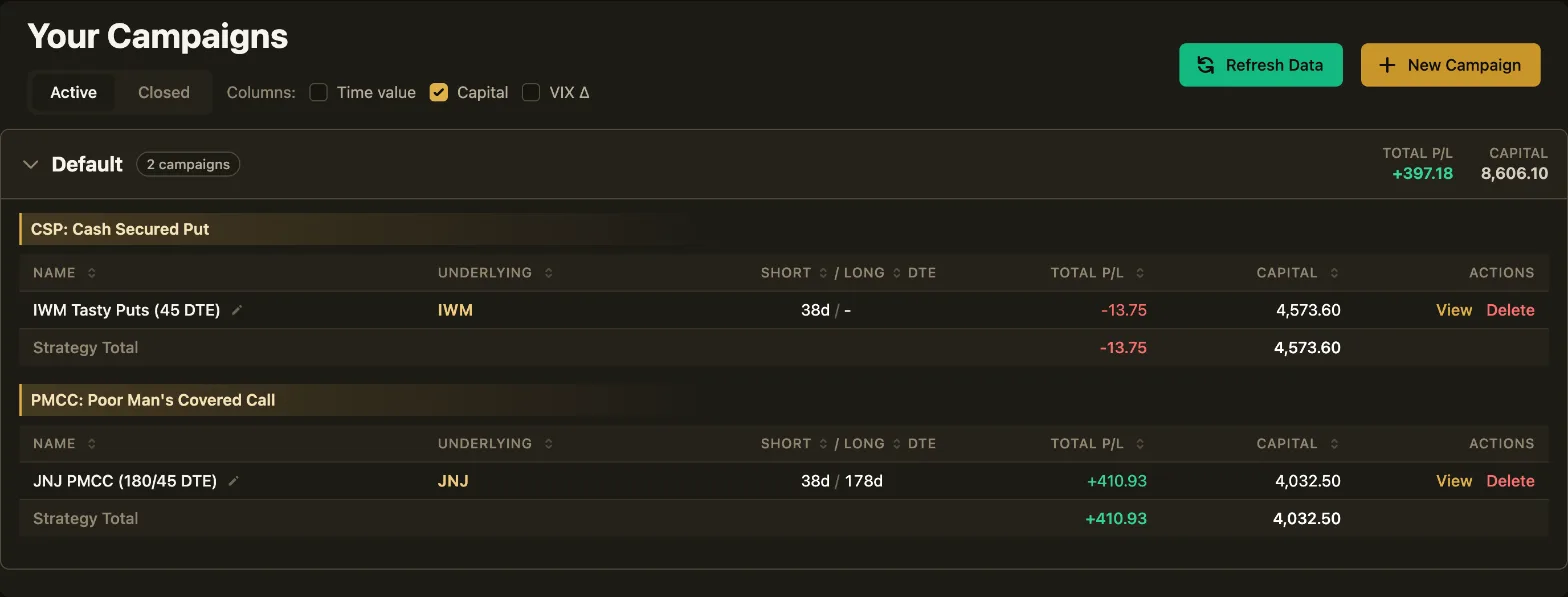
A week after their first trades, this post reviews both example campaigns against their written rules: the IWM puts, sold on October 12, and the JNJ poor man's covered call, opened on October 14. The figures are from The Iron Wheel on Tuesday evening, October 20. It is an example for education, not a recommendation.
The market: a volatility spike
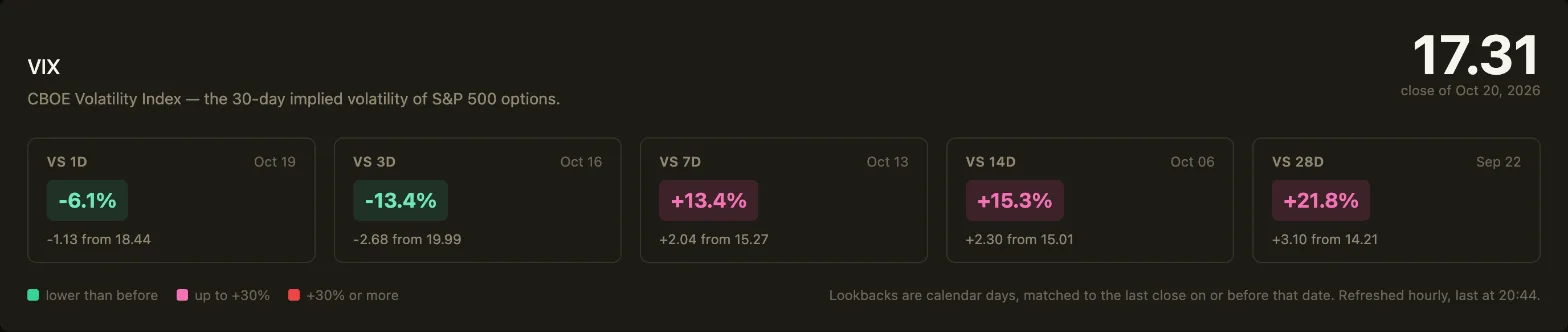
VIX, the 30-day implied volatility of S&P 500 options, closed at 15.27 on October 13 and at 19.99 on Friday, October 16: up 31% in three sessions. By Tuesday it had eased to 17.31. CNN's Fear & Greed index for stocks went from 44 a week earlier to 23, extreme fear, at Monday's close, and read 27 on Tuesday.
Higher implied volatility raises option prices. For a seller about to open a trade that means more premium; for one already short, the same rise shows up as an open loss.
IWM puts: a dip toward the strike
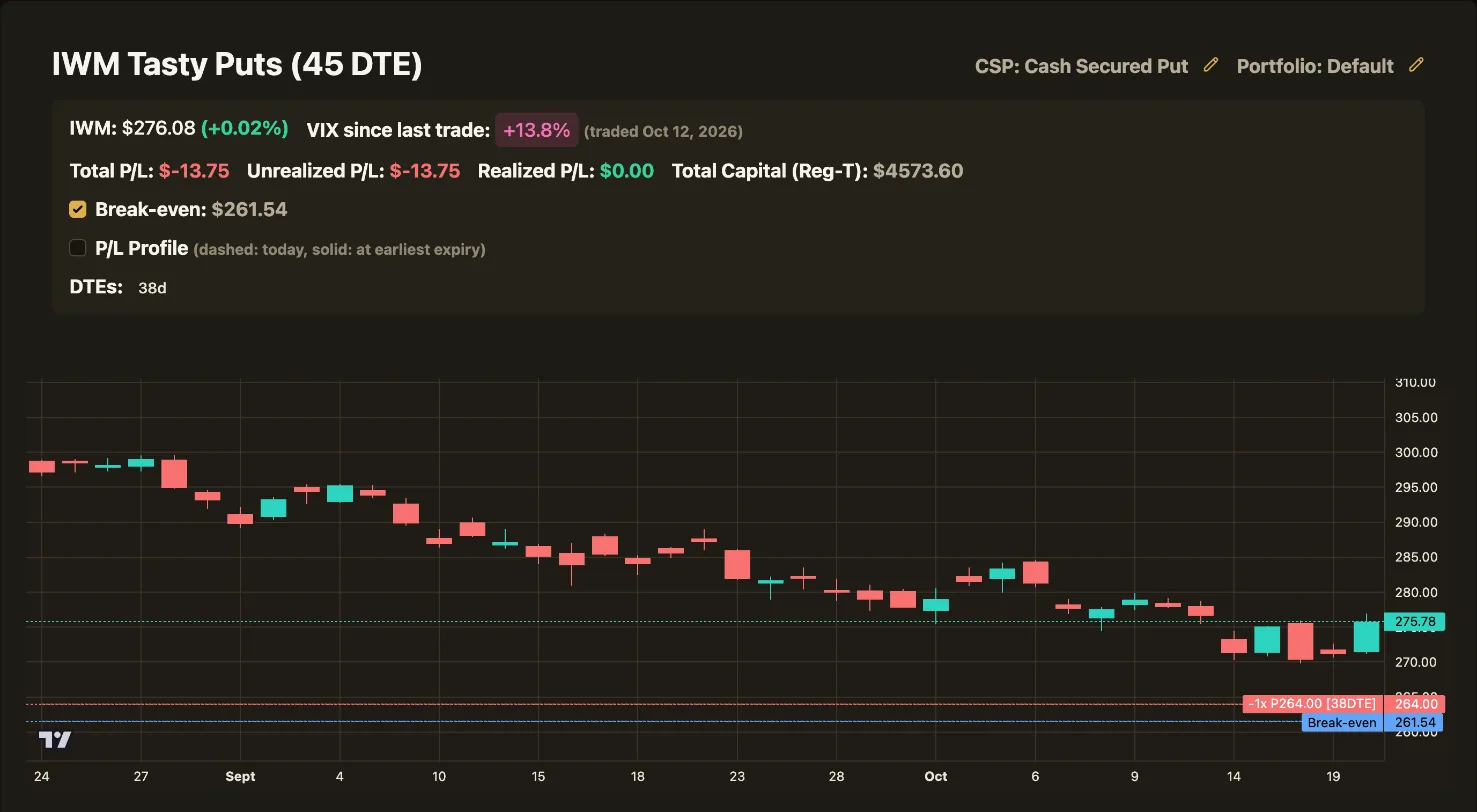
IWM was at $277.95 when the put was sold. It fell to $269.88 on Friday, 2.2% above the 264 strike, and was back at about $276 by Tuesday. The campaign swung with it: from an open loss of $172.25 on the morning of October 15, as the first post showed, to $13.75 on Tuesday, with the put marked at $2.60 against the $2.47 it was sold for.
On its own, eight days of time decay would have taken about 48 cents off the put. By a Black-Scholes estimate, two things put it back: IWM is still $1.87 below the entry price, worth about 39 cents to the put, and IWM's implied volatility has edged up from about 20% to 21%, worth about 22 cents. VIX rose 14% over the same eight days, but VIX measures the S&P 500, and IWM's own options moved far less.
No rule calls for a trade. The put is far from the $1.24 profit target, it reaches 21 days to expiration on November 6, and the $261.54 break-even is about 5% below IWM. The put stays open.
JNJ: the short call in the red, the pair in the black

JNJ fell 5.7% on October 13, the day before the trade, to $248.61. It has recovered since and stood at about $259 on Tuesday. The long 220 call has gone from $39.45 to $45.80, a gain of $634.22, and the short 265 call from $3.25 to $5.48, a loss of $223.29. Together that is $410.93, 11% of the $3,621.57 debit, in six days, and most of it comes from JNJ's price rather than from volatility.
A short call losing money as JNJ rises is the structure working, not failing. The long call, at 0.83 delta, gains faster than the short call, at 0.41, loses, and together the pair moves like 42 shares of JNJ.
The number to watch is the short call's delta. It was sold at about 25 delta and is now 0.41, with JNJ about $6 below the 265 strike. If JNJ moves through $265, the plan is to roll the short call up and out, to a higher strike and a later expiration, most likely for a debit; under the rules the long call is then rolled up with it.
No rule calls for a trade yet. The short call is far from the $1.62 profit target and reaches 21 days to expiration on November 6. The long call has 178 days left at 0.83 delta, well clear of its 90-day and 0.70-delta triggers, and the $249.05 break-even is about 4% below JNJ. Both legs stay open.
The plan from here
- November 6. Both short options reach 21 days to expiration. Whichever is still open is closed or rolled out to about 45 days.
- Profit targets. Good-till-canceled orders to buy back the IWM put at about $1.24 and the JNJ call at about $1.62 each take half the credit.
- JNJ through $265. The short call is rolled up and out, and the long call with it.
The next review follows in a week.