Blog /
An iPMCC on UPRO: selling in-the-money calls every week
A poor man's covered call whose short call lasts a week and is sold in the money. The rules and the first trade on UPRO, the 3× S&P 500 ETF, with about $250 to gain this week at best and the $3,075 debit at risk.
By Team Iron Wheel
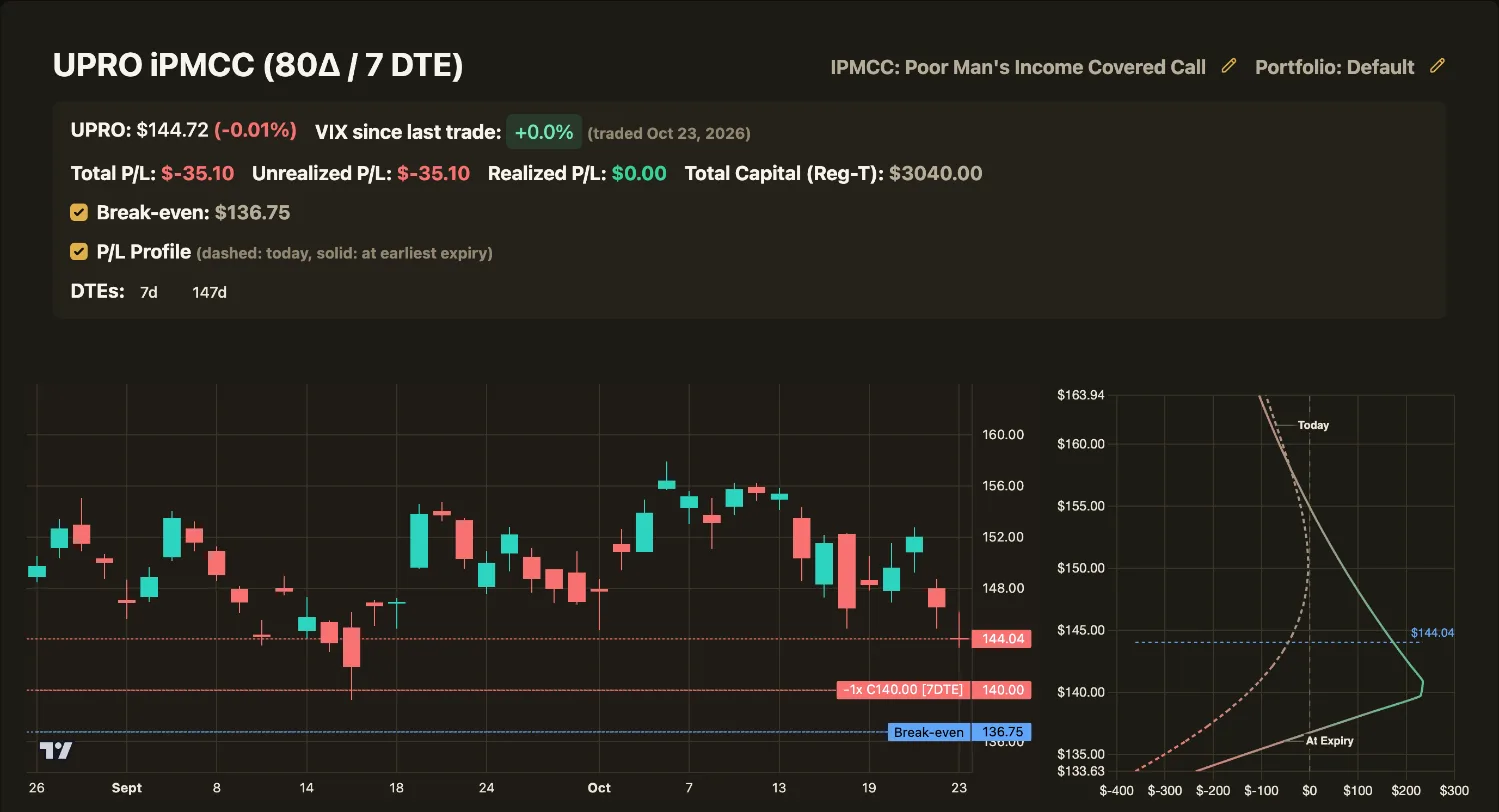
An income poor man's covered call (iPMCC) sells a call that expires in a week against a deep in-the-money call that expires months later. This third example campaign runs one on UPRO, the 3× S&P 500 ETF, following the approach Tom King popularised. The trade went on Friday morning, October 23, and the figures below are from that evening. It is an example for education, not a recommendation.
| At a glance | |
|---|---|
| Strategy | Long 80-delta call, short 7-day 70-delta call |
| Directional assumption | Neutral, slightly bullish |
| Ideal implied volatility | Steady or rising |
| Max profit this week | About $250, with UPRO at $140 on October 30 |
| Max loss | $3,075.10, the debit |
| Break-even | $136.75 on October 30 |
| Capital | $3,075.10, about 21% of 100 shares |
What an iPMCC is
A covered call owns 100 shares and sells a call against them. A poor man's covered call swaps the shares for a deep in-the-money call months out, as in the JNJ campaign. The iPMCC keeps that long call and changes the short one. It expires in a week, and it's sold in the money.
Selling in the money sounds backwards. But a call close to the money carries the most time value, and a week-long one loses all of it by Friday. The part that's in the money works as a cushion: it falls when UPRO falls, and offsets most of the long call's loss.
| JNJ PMCC | UPRO iPMCC | |
|---|---|---|
| Short call | 45 days, 25 delta, out of the money | 7 days, 70 delta, in the money |
| Rolled | At 50% of the credit, or at 21 days | Every Friday |
| Pair moves like | About 50 shares | About 14 shares |
| Strike width against debit | $45 above a $36.22 debit | $25 below a $30.75 debit |
Why UPRO
A weekly short call needs a volatile, liquid underlying, or the premium isn't worth the work. UPRO aims for three times the S&P 500's daily move, and its weekly options trade actively.
The leverage cuts both ways. UPRO resets it every day, so over months it can trail three times the index's return, most of all in a choppy market.
The rules
| Leg | Open | Roll |
|---|---|---|
| Long call | Buy at about 80 delta, months out | Re-centre to 80 delta once it leaves 77–82 |
| Short call | Sell at about 70 delta, about 7 days out | Every Friday, or once its time value drops below $0.05 |
- 7 days. Time decay runs fastest in an option's last week. By a Black-Scholes estimate, the short call loses about 28 cents a day and the long call about 5.
- 70 delta. In the money, the short call still carries about $2 of time value. Its intrinsic value drops as UPRO drops, so the pair moves like 14 shares of UPRO, against 80 for the long call alone.
- Fridays, or under $0.05. A short call with no time value left has nothing more to earn. In the money, it's also a candidate for early assignment. The roll starts a fresh week.
- 77 to 82 delta. The band keeps the long call about 10 delta above the short one, so the pair stays slightly long. Re-centring sells the long call and buys a new 80-delta one.
The trade
Both legs filled in the same second on Friday morning, with UPRO near $145:
| Detail | Long call | Short call |
|---|---|---|
| Order | Buy 1 UPRO Mar 19 2027 115 call | Sell 1 UPRO Oct 30 2026 140 call |
| Days to expiration | 147 | 7 |
| Price | $37.91 a share, $3,791 | $7.18 a share, $718 |
| Commission | $1.04 | $1.06 |
| Net | $3,792.04 debit | $716.94 credit |
Net debit: $3,075.10, or $30.75 a share.
The short call's $7.18 was about $5 of intrinsic value and about $2 of time value. That $2 is what the week sells. On October 30 the call expires worth its intrinsic value and nothing more.
Max profit, max loss and break-even
This week's figures come from the app's P/L profile, which prices the long call at Friday's implied volatility. They're estimates.
- Max profit this week: about $250, with UPRO at $140 on October 30. The short call expires worthless, and the long call keeps about $8 of time value. If UPRO just sits near $144, the profile puts the gain at about $170.
- Break-even: $136.75 on October 30, about 5% below Friday's close. Below it, the long call keeps losing value, and the short call has none left to give back.
- Max loss: $3,075.10, the whole debit. It takes UPRO below $115 when the long call expires in March. Each week's time value, once collected, lowers it.
- Above about $155, the pair loses money. Past $140, each dollar UPRO gains costs the short call a dollar and earns the long call less. The pair can't be worth much more than the $25 between the strikes, and it cost $30.75.
However far UPRO runs, the loss on a rally has a ceiling:
Most it can lose on a rally = debit − strike width = $3,075.10 − $2,500 = $575.10
The long call carries one more risk. The pair is long vega. By the same Black-Scholes estimate, each point of implied volatility is worth about $17 to it. A fall in UPRO's volatility hurts the long call more than it helps the short.
Where it stands

UPRO closed Friday at $144.04, about a dollar below the fill. The pair was down $35.10. The long call lost $47.04, and the short call made back $11.94. The screenshots show $144.72, an after-hours price, and the app works out the break-even and P/L profile from it.
No rule applies yet. The short call has its whole week ahead, and the long call sits at 0.80 delta, in the middle of its band.
The plan
- Friday, October 30. The rules roll the 140 call to next week's 70-delta call, or sooner if its time value drops below $0.05.
- The long call. If UPRO pushes its delta outside 77–82, the rules swap it for a new 80-delta call.
- Next week. The next weekly review covers all three campaigns.
Summed up
- An iPMCC is a poor man's covered call whose short call lasts a week and is sold in the money.
- This week's short call sells about $2 of time value, and its intrinsic value cushions a fall.
- This week the profile's best case is about $250 at $140, with a break-even at $136.75.
- A rally past about $155 loses money, because the debit is bigger than the strike width.
- The most the pair can lose is the $3,075.10 debit.